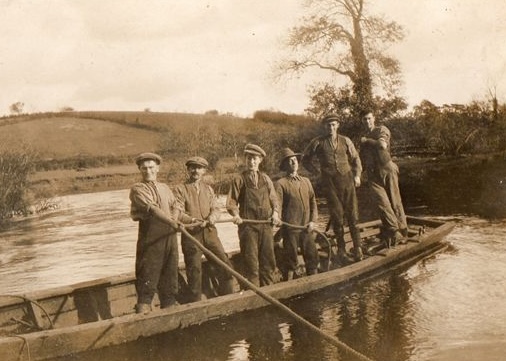
I am intrigued by the idea of this man who, through his connection to the southwest Fermanagh landscape, epitomised toil, risk and innovation in a time of great industrial change a hundred and fifty years ago. All we know about Willie Lunney comes from a scrap of oral folk memory, but it’s enough to inform us that a place named after him was where large flat-bottomed wooden cots manoeuvred at a turning point on the Arney River.

Still recognisable today on satellite maps, this small three-sided dock in Rossdoney townland is located about a mile inland from where the river enters Upper Lough Erne at Ballymenone (Baile Bun Abhainn: river mouth), a place made famous by American folklorist and writer Henry Glassie in his book Passing the Time in Ballymenone.

In Lunney’s day (he was the likely grandfather of Willie Lunney mentioned by Glassie) the river was clearly busy enough with commercial boat traffic to encourage him (or if not him, perhaps local farmers-cum-brick makers) to invest in widening the river by excavating the riverbank sometime in the nineteenth century so that cots could better load cargos of slap bricks for delivery to Enniskillen, eight miles downstream to the north.
Bricks were made to order by local farmers in temporary clamping kilns in the summer months at scores of sites in Rossdoney, Drumbrughas, Derryhowlaght and Clontymullan townlands. In times of low water, there is still evidence of the extent of this unregulated activity where thousands of discarded broken bricks can be seen on the riverbed at loading points. Here, too, folk memory recalls the spectacle of smoke and flames rising on still summer evenings from numerous temporary turf-fired kilns built close to the river to ease the loading of smaller cots with finished bricks.

If it hadn’t done so before, Willie Lunney’s working life certainly came to its own inevitable turning point when brick-making along the Arney River died out in the 1930s. The industry had outlasted, by several decades, an earlier 18th century industrial boom initiated by his neighbour, landlord and entrepreneur, Lord Cole.

Around 1764 William Willoughby Cole (soon to become 1st Earl of Enniskillen) moved to his new house at Florence Court in southwest Fermanagh at a time when British and European landscapes were being transformed by the Industrial Revolution. In the latter part of the 18th century Ireland remained agricultural due largely to an absence of raw materials such as coal and charcoal. Economic activity was focused on the linen industry which was vital to the thriving rural economy, and water mills became the most common industrial structures developed by landlords. His land around Florence Court House had abundant water sources and space for bleach greens and was ideal for the development of advanced facilities needed to process not only linen, but other innovative industries too.
For the next hundred years successive Earls of Enniskillen built an impressive portfolio of small innovative water-powered businesses, most of which have now disappeared, including Moneen corn mill, Gortnacally sawmill, Gubbacrock corn mill and kiln, Knockageehan cotton factory, and the Florencecourt Tile, Brick and Pottery works. Some fragments remain, however.

Tully mill and cottage were built around 1766 as a manor mill, and its innovative mechanism was regarded as one of the best examples of power transmission in Ulster at the time. It was fed by a mill race from the Larganess River close to the Big House, as was the race to a pond and water wheel that still drives a sawmill there today. Tully Mill operated until the Second World War before falling into dereliction. It was restored in 2001 by Killesher Community Development Association (KCDA) and converted into a restaurant. What is not generally known is that Tully Mill was connected by another mill race from its mill pond to a much larger sister mill shown on the 1832 OS map as a candle wick manufactory.

Credit: Gemma Mannix. Courtesy: KCDA.
Now derelict, this impressive three-story building was continuously worked for over two hundred and fifty years by adapting its use to changing economic and market needs. Built as a linen mill it used surrounding fields as bleaching greens until 1789, when a machine was installed to make wicks for candles and oil lamps by utilising cotton waste from a local cotton factory, also built by the Earl of Enniskillen at Knockageehan at the foot of Claddagh Glen, and another at Beggar Street, in Enniskillen. Between 1792 and 1825, the candle wick manufactory was the largest in Ireland. Candles were also produced from tallow. In later years it became a scutch mill, corn mill and sawmill before a second water wheel was added in the early 1900s, and in 1923, a Craig turbine was installed to generate power. Finally, a diesel engine drove a modern sawmill, which survived up until the 1960s. An architect’s impression of the building was recently commissioned by KCDA, which shows this impressive structure as it might have once looked.
Both sister mills are now isolated from Florence Court House and Demesne. They were sold on by the 5th Earl who later transferred the Big House to the National Trust in 1954 and the Demesne to the Forestry Service in 1974 which then fixed the current boundary. An umbilical cord was severed, and these mills, along with other industrial sites once associated with the Coles became largely forgotten, and their historical importance lost.

Credit: Davey Dane. Courtesy: KCDA.
Nothing remains today of Florencecourt Tile, Brick and Pottery Works which operated from 1845 to 1898. Built by the 4th Earl as a famine relief project, it produced factory-standard bricks, tiles and drainage pipes. Layers of its square, round and fishtail-shaped roof tiles can still be seen today on the roof of a derelict cottage outside Florencecourt village, perhaps the last building of its kind anywhere. The use of these materials was a distinctive and rare feature of local architecture in southwest Fermanagh, and possibly unique in Irish vernacular architecture of the period. An architect’s impression of this building was also commissioned by KCDA to illustrate it as it would have looked originally, and local school children made roof tile replicas as part of its water wheel heritage project.

Photo: Barney Devine.
The Tilery employed up to 200 workers (seasonal and core) who cut and hauled turf from nearby bogs, extracted clay and moulded products for firing in permanent kilns. As we have seen, these same veins of clay and peat bogs provided the raw materials to generate additional income for local farmers in Arney, who, throughout this period and after, continued their traditional slap brickmaking activity downstream where, I like to imagine, Willie Lunney plied his trade.
The KCDA project also discovered that its old millstones probably came from sandstone outcrops high up on the lonely moorland summit of Slieve Rushin on the Cavan/Fermanagh border, where abandoned millstones were located at several quarry sites. This long-forgotten industry was at its height before the famine from the 1750s to 1840s, and again was mostly carried out by subsistence hill farmers who produced to order a range of millstone types and sizes for mills in nearby parishes and counties.

When both formal and informal industries are taken together, we can envisage a landscape peppered with commercial activity generated by people like Willie Lunney and Lord Cole stretching from Slieve Rushin to the Arney River that included water-powered mills, factories, and smoke-belching kilns fuelled by locally extracted peat. Busy transport hubs and networks were developed on water and land, high-quality millstone-making quarries were opened up, and a range of allied trades were supported throughout.
Collectively, they formed a social, cultural and economic synergy not previously fully considered, yet which arguably produced one of the most important rural industrial landscapes in the 18th and 19th centuries, not only in Fermanagh, but in west Ulster.

Thanks to Killesher Community Development Association (KCDA), Templeport Community Centre, Kinawley Community Centre, land owners, Marion Maxwell and all those who participated in the recent Tully Mill Water Wheel Community Restoration Project funded by The National Lottery Heritage Fund.


Leave a Reply