The dog had to be walked, but given the day that was in it, I wasn’t enthusiastic about going out. A grey membrane of cloud hung low over the hills of southwest Fermanagh. It was wet and dreary. I was indecisive about where to go. Then I remembered a route I had been meaning to check out, so with little enthusiasm, I headed out to see where it might take me.
I was soon sauntering through a hazel wood on a lane contained within low stone walls. Gurgling streams tumbled down through culverts. Having no destination in mind, I followed it up a hill, stopping only when my attention was drawn to ripples on the surface of gravity-defying ponds of water retained by banks and shallow dells; mating frogs were making the most of the wet, early Spring weather.
Above the tree line, the fine enclosing rain stopped. I joined a network of old footpaths that linked together several isolated derelict cottages corralled behind their moss-covered walls. A huge gaping bomb-like crater dropped away precipitously from the side of a path; a swallow hole, created by a collapsed roof of an underground cave, was dramatic evidence that this was limestone country. From here, I surveyed the valley below and the heather-clad hills above and wondered about the social and cultural glue that once bound this community together on this now depopulated rushy plateau.

Walking to a large walled field enclosure, my eye settled on a scattering of ruined gable walls barely visible through a copse of leafless trees. Approaching the dismembered buildings, I saw a large mature tree with three large boulders sheltering under its branches. I had seen this cluster type before. Befitting my relaxed attitude, I assigned it to be the last stop of my unhurried tour of the site because I had a hunch, which, if right, might mean that I could have a discovery on my hands, and I wanted to savour the moment. I continued exploring the site of what was now clearly emerging as an 18th or 19th century clachan, a now vanished form of communal village life and its associated Rundale farming practice based on shared risk and benefit.
Drawn to a sound source of flowing water, I became aware that I was walking across regularly spaced ridges, or potato lazy beds, long abandoned and now solidified in this shallow upland soil. Locating a stream close to an outhouse where it disappeared underground, I further tracked its audible sideways course down and along a nearby horizontal gash in the limestone rock. Another rivulet flowed out through the front door of a ruined cottage before it, too, dropped into a small swallow hole. The acoustic background to the place was dominated by cascading water; the clachan had been built above a porous underground world of caves shaped by flowing watercourses, which appeared and disappeared at will.

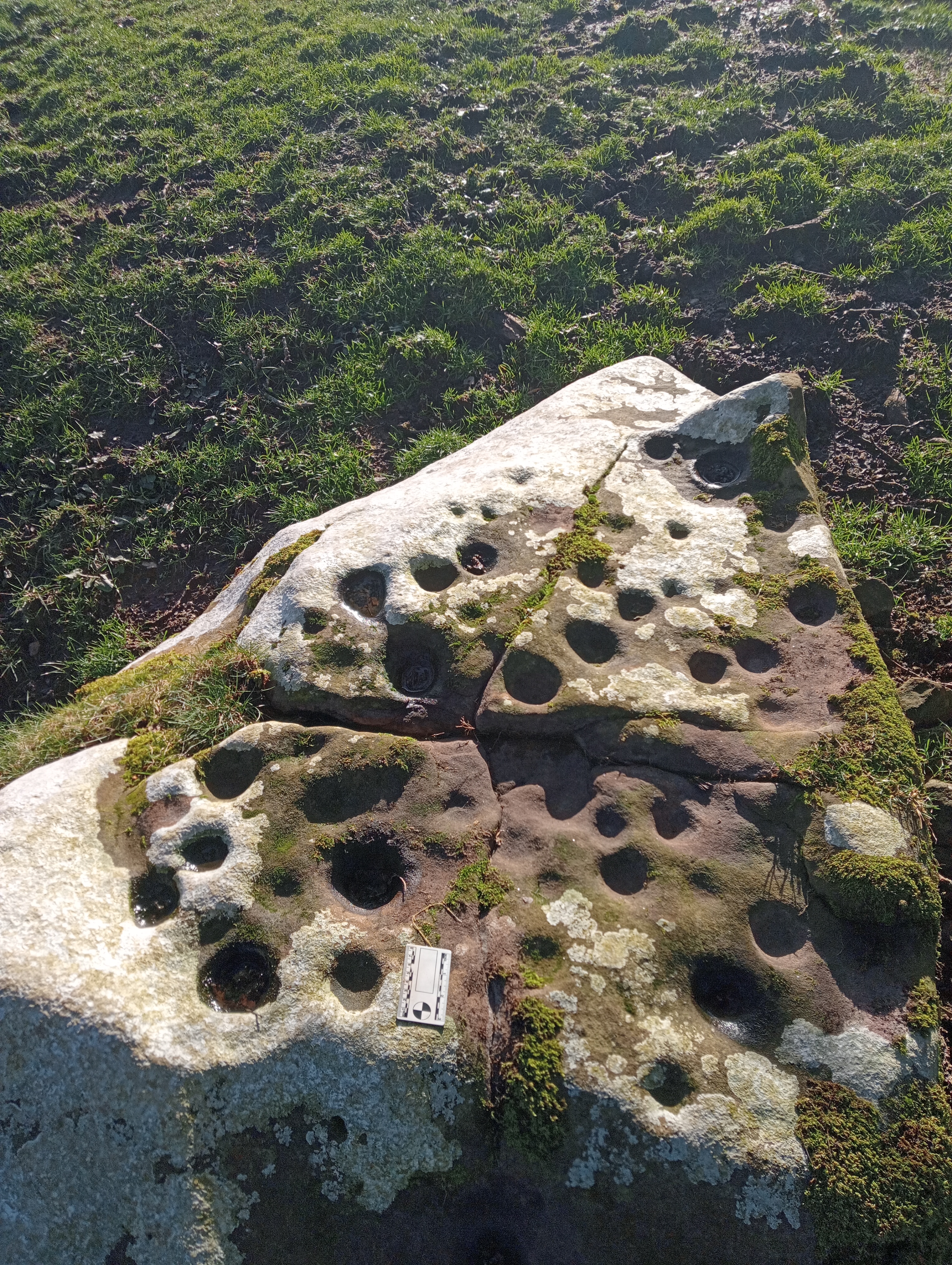
Coming around the gable end of the last building I finally neared the boulders and tree, which, from this new perspective, were set against a panoramic view of the valley below. The first two boulders rested horizontally on the ground. The third was upright on its side. As I drew close, I immediately saw small bowl-shaped hollows on the flat surfaces. Known as Atlantic Rock Art, these small motifs were carved out by our ancestors between 4000 and 2000 BC. My deliberate meander had led me to a special place, and I was not disappointed.
Usually engraved on upward faces of natural exposed bedrock and boulders by Neolithic and Early Bronze Age farmers, these enigmatic abstract symbols are found along the Atlantic seaboard of western Europe from Ireland and Britain to Portugal and Spain. The most common design element, or motif, in Ireland is the simple cup mark. Other more elaborate symbols include rings, rosettes and spirals. We do not know what their original purpose was, but they are a most intriguing aspect of our ancient past. Some subjectively suggest that these carved stones may represent abstract maps of the landscape or markers of territories and meeting places, or perhaps were ritual spaces for initiation rites. Others surmise that the decorated platforms were places where the dead were exposed to let nature deflesh the bones.

The position of motifs is also associated with natural features on the rock surface, such as hollows, cracks, or raised areas. Unlike hieroglyphs from ancient Egypt, which have been decoded and translated as a written script, Atlantic Rock Art is not a language and cannot be read. The most intricate and elaborate Rock Art found in County Fermanagh is at Reyfad near Boho. Indeed, well-known local landscape explorers Gaby Burns and Jim Nolan have contributed much to our knowledge of Rock Art through their intimate deep mapping of the Cavan Burren landscape, where they have discovered many sites.

The decorated boulders at this abandoned clachan are not officially recorded anywhere, so was I the first person in 6000 years (or thereabouts) to identify them as Rock Art? Maybe, maybe not. Others, though, seem to have had at least an awareness that this place was different. Large nearby stones and boulders have been extracted mechanically from the surrounding land and used to form rough perimeter field walls, yet these three were left in situ, as if curated by hands unseen. Undocumented, it remains safe in the wild.
I like to imagine, then, that this cluster of boulders close to a recent habitation site was used as a gathering place long before the clachan’s recent abandonment, stretching back to the time of our early neolithic farmer ancestors who sculpted their motifs. Perhaps children played on them, and elders gathered there to trade chat and contemplate their own time and place in this tinkling, mysterious, elemental world of rock and water.

Rock Art can’t be viewed in modern galleries, as it is site specific and earth fast. To see and experience them, we have to go to their landscape locations. There are undoubtedly more of these wonderfully enigmatic monuments to be found. Should you be a-wandering on upland stony ground you too might “get your eye in”, and perhaps make your own personal discovery to add to the fabulous story of Atlantic Rock Art.

Photo Jim Nolan.


Leave a Reply