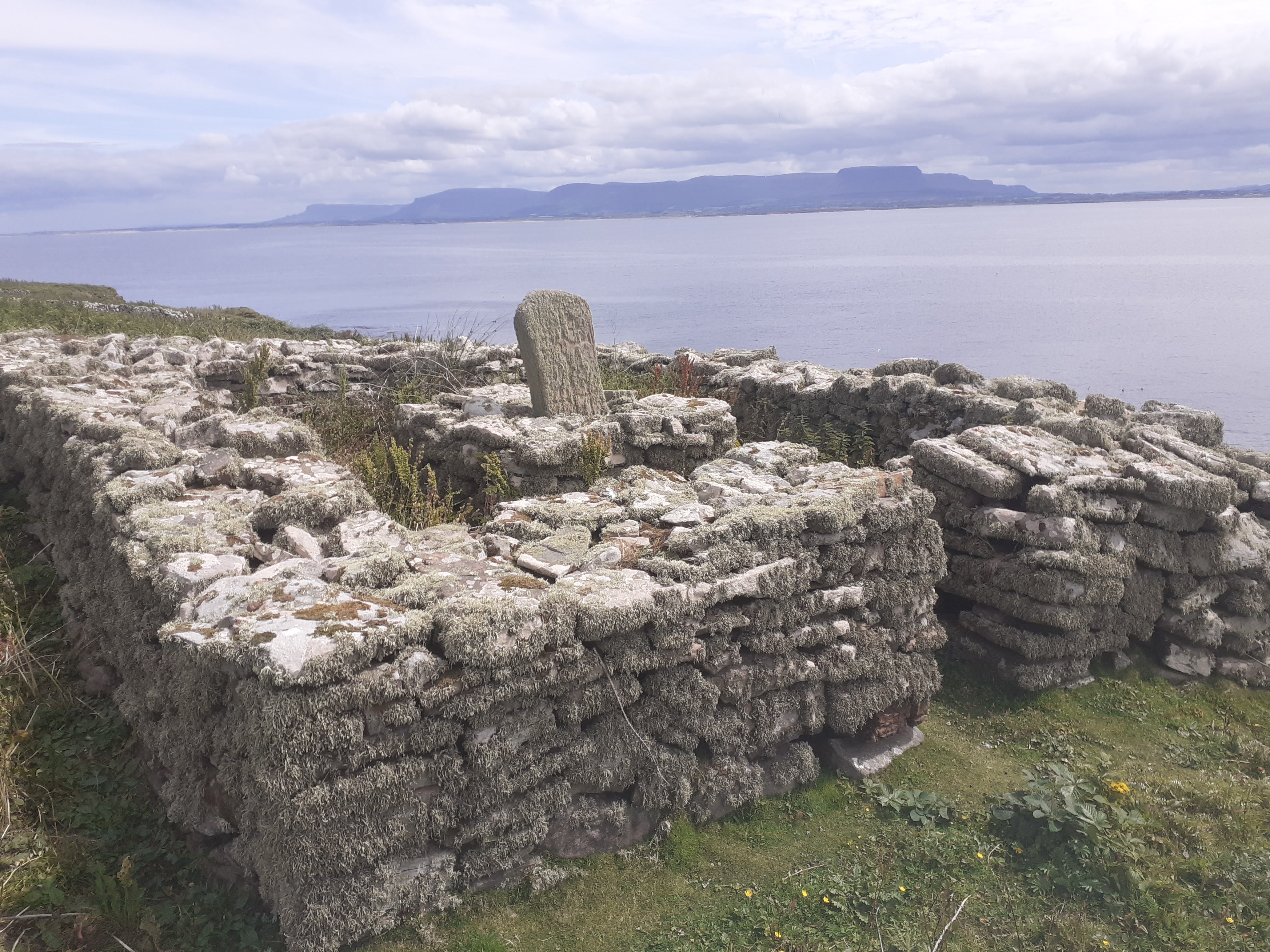
The day was warm and sunny and the sea was calm. My companions were in high spirits, and full of chat about recent politics. Launching the rib, the skipper wondered aloud if there would ever be a united Ireland. Given the destination and our eagerness to be away the question seemed out of place, and was conveniently left unanswered. We wanted to look back in time, not forward. Our journey to the early medieval Christian monastery on Inishmurray island in Donegal Bay was greatly anticipated. It would be a day for taking a long view of history.
Located six miles from Mullaghmore Harbour, the treeless island is low lying and difficult to access. Chosen by St Molaise (who also founded Devenish Island on Lower Lough Erne) as a site for a monastery in the early sixth century. It was a tough place to inhabit, and may even have been a purgatory. Much later in the early 19th century people settled there and made a living from fishing and poitin. They found it tough too, and the last islanders returned to the mainland in 1948. Against a majestic view of distant Ben Bulbin, their abandoned houses now line a street just above a low exposed south-facing cliff.

The Annals record that Vikings came ashore here in 795 AD, and again the following year. Easy monastic pickings. Being on the spot where recorded attacks like this occurred felt instinctive; on a small remote isolated island, where could you run to?
Within its circular stone wall enclosure, the monastic site contains beehive huts, church, graveyard, and other buildings. Around the island perimeter are sixteen altar stations used by monks and pilgrims for prayers, many of which are topped with round shaped cursing stones. Much is written about these strange stones that nestle into recessed bowl shapes on surfaces of boulders and altars, here and elsewhere. Used by Early Medieval church leaders to extend their influence by cursing the actions of warlike overlords in times of trouble, they may have had pre-Christian origins. Our chat turned to other possible pagan rituals still being practiced today – scooped out bullaun stones which were brought into churches and reused as holy water fonts, ritual wells and associated cures rebranded as holy wells and connected to early Saints and their churches built nearby, and rituals or prayers said at outdoor circuit altars by monks and relocated over time into chapels to become stations of the cross.

Our skipper had promised mackerel for lunch, but failing to catch any, we swam in a deep rocky channel before settling down to sandwiches. Conversation turned to how religious and cultural practices had been absorbed into, and influenced by, successive waves of settlers and invaders: early Christianity incorporated pre-existing pagan practices, raiding Vikings eventually settled and turned to trading, invading Normans became more Irish than the Irish. Eventually all became part of the mix. Surely the later effects of Plantations, Huguenots, migrants, and recent inflows of refugees from around the world will all follow a similar course. Indeed, after more than 1500 years since the arrival of Saint Patrick we might be witnessing the emergence of a new post-Christian Ireland. Things change. Tides cannot be ignored. It was time to go.
Driving back to Enniskillen we visited the Church of Ireland at Rockfield close to the shores of Lower Lough Erne to see an upright stone in the graveyard. Originally when it was laid out horizontally it had several large hollowed out bowl shapes on its surface in which cursing stones once nestled, similar to those on Inishmurray. Some time later a Christian cross had been carved in relief on the other side, and it was repositioned as an upright stone. Here then, was further evidence of religious assimilation and repurposing. Perhaps the adjacent Protestant church had been built on an earlier ecclesiastical site, which in turn had been a pagan site before that.

My fellow explorers were thoughtful. “Everything is layered and through-other,” said the skipper. “Ireland – whatever that is – will have the final say on unity – whatever that might look like – in its own time and way.”
“Aye,” said the other, “given what we have seen today maybe we should give it another couple of hundred years or so…”

Leave a Reply